
Seasickness on Phuket Boat Trips — The Honest Andaman Guide
Here's the honest answer up front: anyone can get seasick — even captains. I've skippered boats here for over ten years and I've felt it myself, though only in the kind of 4–5 metre seas we would never take guests out in. On a normal charter day in Phuket, seasickness is largely preventable, and the three things that matter most are simple: stay hydrated (it's the single biggest factor), take a tablet before you feel sick, not after (free on all our boats), and choose a catamaran — two hulls are dramatically more stable than one, which is why our whole fleet is catamarans.
And if it does hit you anyway, there's a fix most people refuse to believe until they try it: jump in the water. The moment the boat's motion stops, so does the sickness — almost immediately.
This guide covers everything our skippers have learned about motion sickness on the Andaman: why it happens, how to prevent it, what to do in the moment, and which boat to pick if you know you're prone.
In short: Drink at least half a litre to a litre of water before boarding and keep drinking all day. Skip the heavy night out beforehand. Take a (free) seasickness tablet 15–30 minutes before open water. If queasy: face the horizon, sit in shade with wind on your face, sip something sugary — and never lie down in a cabin. Prone to it? Book a catamaran, and consider Phang Nga Bay over the open Phi Phi crossing.
Why do some people get seasick and others don't?
Sensitivity genuinely varies from person to person — the same way some people get nausea from a medication and others feel nothing. There's also a real psychological layer: expectation matters, in both directions. If you board convinced you'll be sick, you've made it more likely. That's not weakness; it's how motion sickness works — your brain reacting to a mismatch between what your eyes see and what your inner ear feels (the NHS has a good plain-language explainer).
The good news: on a typical Phuket charter day, conditions are far gentler than most first-timers fear. We start from protected water, the routes are planned around the same-morning forecast.
What's the number one thing that prevents seasickness?
Hydration. It's not what most people expect, but it's what we see proven on the water week after week. Dehydrated guests get seasick far more easily — and a boat day dehydrates you from three directions at once: the sun from above, the sun's reflection off the water from below, and the salty air all day long.
So the routine is simple. Drink at least half a litre to a full litre of water on the morning of your charter, before you even reach the pier. Then keep drinking steadily on board — more than feels necessary.
And the flip side: a heavy night out before your boat day is the classic mistake. If you arrive with a hangover, you're already dehydrated and already feeling rough — the two ingredients seasickness loves most. Save the big night for after the trip.
How do seasickness tablets work — and when should you take one?
Every one of our boats carries free seasickness tablets, as many as you need, and we talk you through them in the briefing before departure. Two things to know:
Timing is everything. The tablets prevent seasickness; they don't cure it once it has taken hold. Take one 15–30 minutes before you expect rough water. Because we depart from a protected bay where the water is calm, you have a comfortable window after boarding to take one before the open stretches.
They're mild, and you can repeat them. One tablet roughly every five hours is fine. If you know you're prone, or you're not feeling 100% that morning, just take one early — there's no downside.
What should you do if you start feeling seasick anyway?
There's a right way and a wrong way, and most people instinctively choose the wrong one.
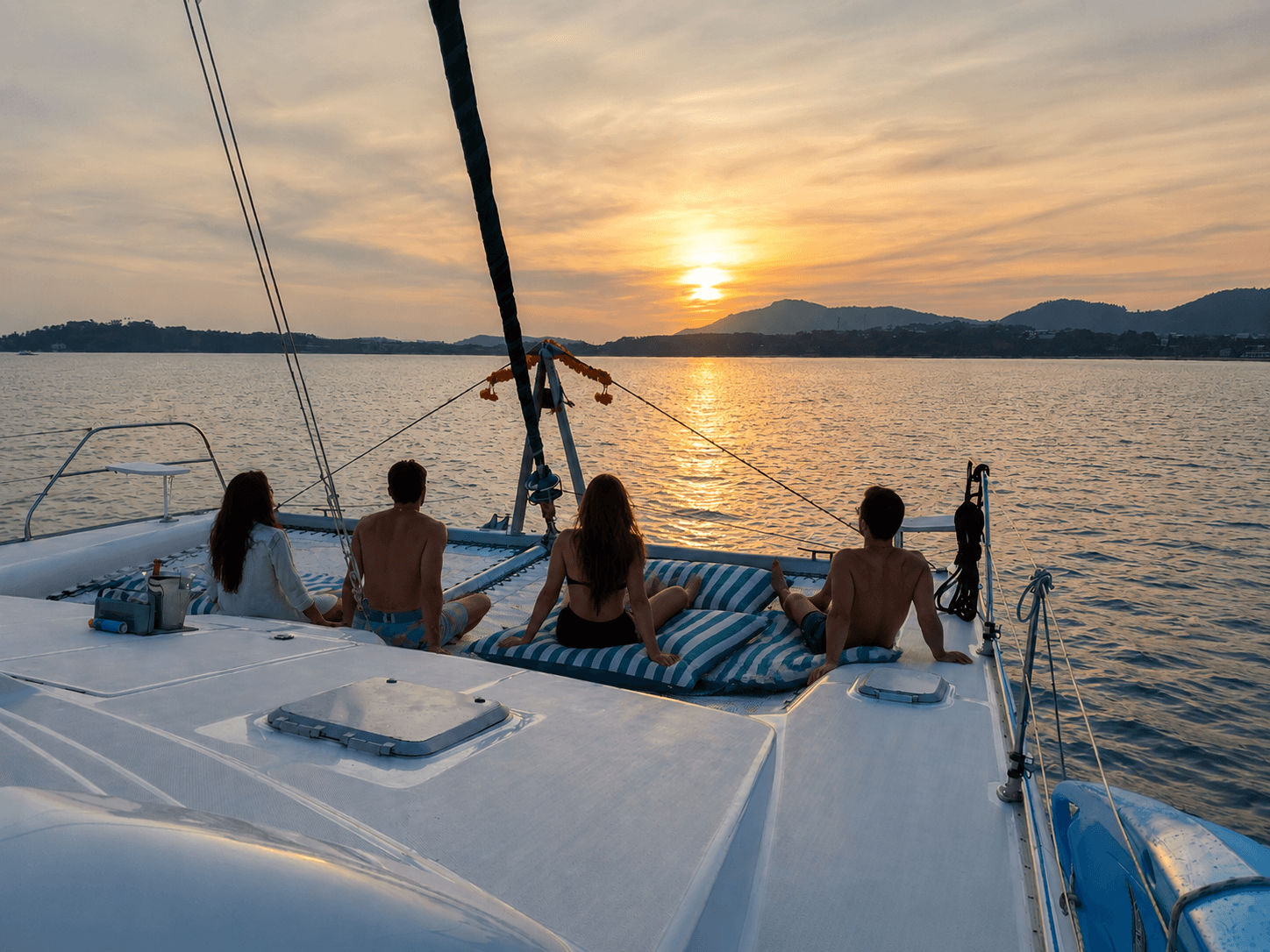
The cabin instinct is the one we fight hardest. Lying down in an enclosed space makes motion sickness dramatically worse — your inner ear keeps feeling the boat while your eyes see a still room. The best seat on a sailing catamaran is the opposite: right at the front, in the shade of the tent or the sail, horizon in view, breeze on your face.
And the counterintuitive champion: swimming. Guests who feel unwell almost always want to stay on the boat — "I don't feel well, I'll skip the water." It's exactly backwards. The moment you're in the sea, the boat's motion is gone, and with it the seasickness — usually within a minute or two. We've watched this work hundreds of times. Trust us over your instinct on this one.
Catamaran or monohull — does the boat really matter?
Enormously — and this is the most useful thing to know before you book, not after.
A catamaran stands on two hulls. That makes it fundamentally more stable than a monohull (one hull), both underway and — crucially — at anchor. A monohull sitting in a bay rocks side to side with every bit of wind and swell, all day long. A catamaran at anchor sits almost still. If you're prone to motion sickness, that difference is the whole game: on a monohull the trigger never stops; on a catamaran it largely disappears every time you stop to swim, eat or snorkel.
This stability is exactly why catamarans dominate the charter world — and why our fleet is all catamarans. If you know you're sensitive, choose a catamaran (or any multihull), full stop.
Which Phuket routes are calmest?
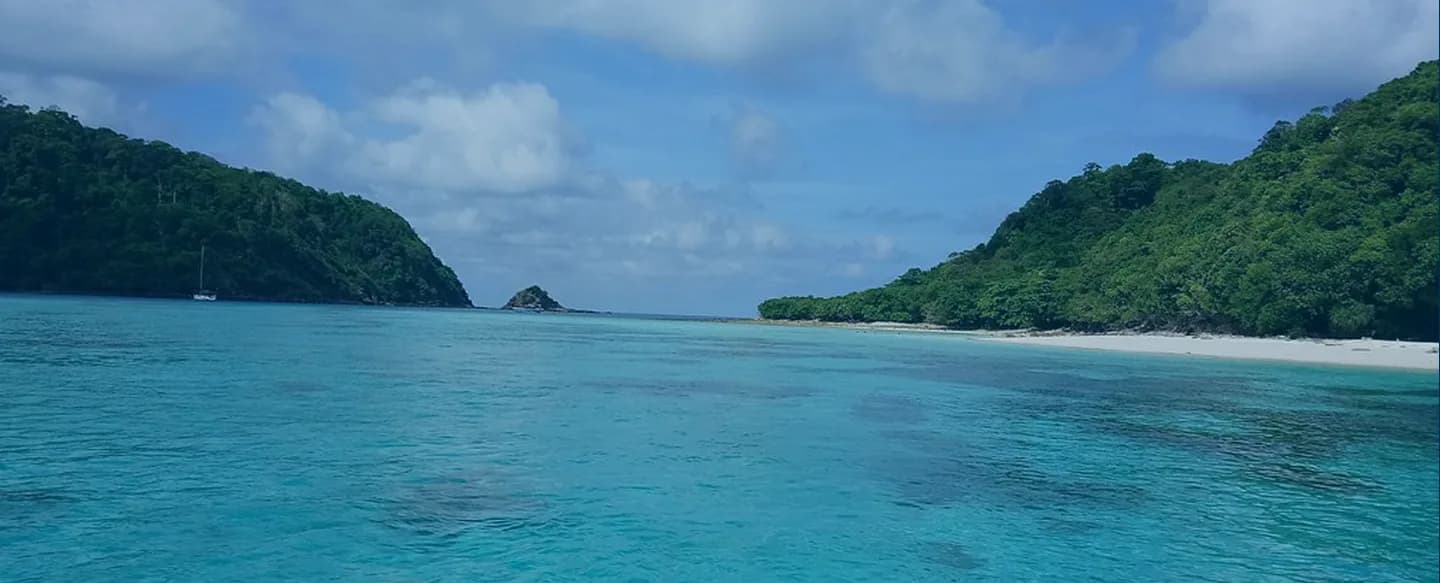
Route matters almost as much as boat. The crossing to Phi Phi is the most exposed run in our area — open water both ways. Phang Nga Bay, by contrast, is sheltered nearly year-round, and spots like Coral Island and Maithon offer short, protected runs with calm anchorages.
We check the forecast for the whole fleet three times a day — Windguru and Windy are the two we trust for the Andaman — and the same-morning check decides the final route. If you tell us in advance that seasickness worries you, we'll build the day around calm water from the start. That one sentence at booking is worth more than any tablet.
FAQ
How common is seasickness on a Phuket boat trip?
Less common than people fear. Most charter days here run in gentle, partly protected water. It appears most often in guests who arrive dehydrated or hungover, or on the exposed open-water crossings in windier months. With basic preparation, most sensitive guests get through the day feeling fine.
Do you provide seasickness tablets on board?
Yes — free, unlimited, on every boat, and we explain them in the pre-departure briefing. They're mild; one every five hours or so is fine. The key is timing: take one 15–30 minutes before open water, not after you already feel sick. Departure is from a calm protected bay, so there's time to take one after boarding.
What's the best natural remedy for seasickness?
Water, honestly. Hydration is the single biggest factor we see — drink half a litre to a litre before boarding and keep going all day. Beyond that: fix your eyes on the horizon, get wind on your face, take on some sugar (a cold Coke does more than you'd think), and swim at every stop. The sea itself is the best cure on board.
Is a catamaran really better if I get motion sick?
Yes, dramatically. Two hulls make a catamaran far more stable than a monohull — especially at anchor, where a monohull rolls side to side continuously and a catamaran sits nearly still. Since a charter day is mostly stops — swimming, lunch, snorkelling — that anchor stability is what your stomach notices most. Our entire fleet is catamarans for exactly this reason.
Should I just not eat before the boat trip?
No — an empty stomach tends to make it worse. Eat a normal, light breakfast and skip the greasy or heavy options. What matters far more is what you drink: plenty of water beforehand, no alcohol excess the night before, and steady water all day on board.
What happens if someone is sick in a cabin?
It happens — and it's why we coach guests so firmly away from the cabins when queasy. Lying down below deck makes seasickness worse, and if the worst happens in the bedding, a cleaning fee applies. Stay up top, face the horizon, and let the crew look after you — they've seen it all and know exactly what helps.
Which trip should I book if I'm very prone to seasickness?
Tell us when you enquire — it changes our recommendation. We'll point you to a catamaran (all our boats), a sheltered route like Phang Nga Bay, Coral Island or Maithon rather than the open Phi Phi crossing, and a season-appropriate plan. The calm-water day is every bit as beautiful; it just keeps your inner ear out of the conversation.
Nervous about seasickness but dreaming of a boat day? Tell us on WhatsApp — one message about who's coming and what worries you, and we'll match you with the calmest boat, route and season for your dates.→ Private day charters
About the author:
Florian "Flo" Tretter
Florian "Flo" Tretter is co-owner of Faraway Yachting in Phuket. He has spent more than ten years in the industry — as a dive instructor, yacht captain, yacht manager and now company owner. Faraway Yachting has operated from Chalong Pier since 1997 and holds 950+ five-star reviews.